
Open Work Permit Canada: Complete Guide 2026
An open work permit lets you work for almost any employer in Canada without a job offer and without a Labour Market Impact Assessment (LMIA). Its biggest advantage is freedom: you choose your employer, your occupation and where in Canada you work, and you can change any of them while the permit is valid.
This guide explains the main types of open work permits, who qualifies, how to apply and extend one, and how a work permit compares with permanent residence. Immigration rules, fees and processing times change often, so always confirm the details with Immigration, Refugees and Citizenship Canada (IRCC) before you apply. This page is general information, not legal advice.
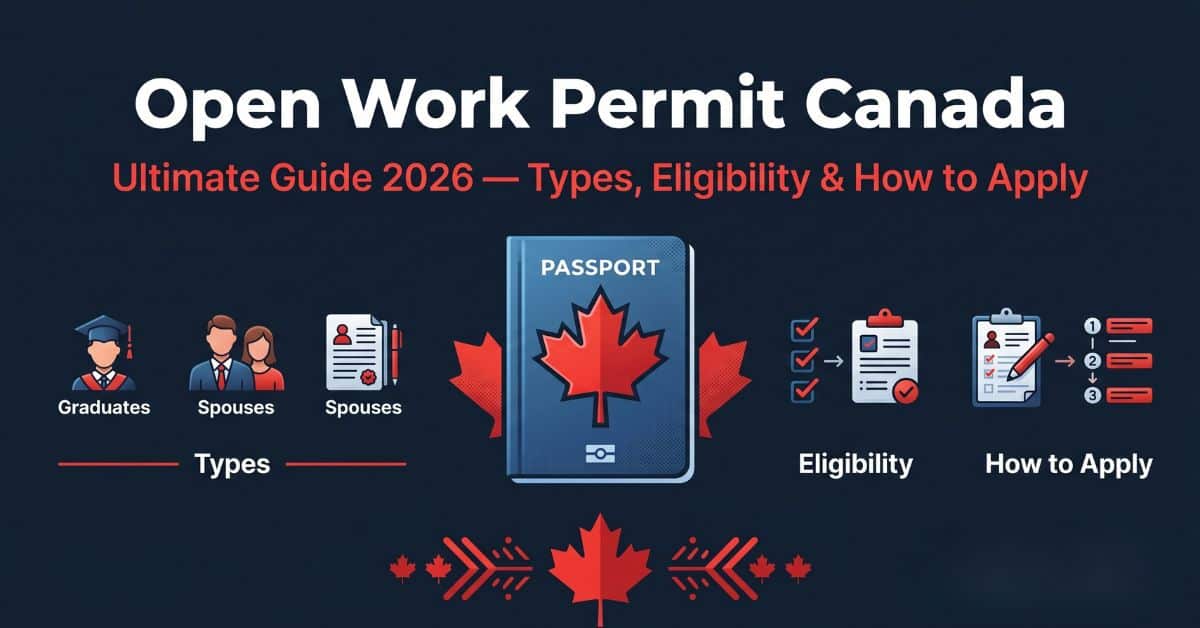

What is an open work permit?
Most foreign nationals need a work permit to work legally in Canada. There are two kinds:
- Employer-specific (closed) work permits name one employer, and often one occupation and location. Changing jobs usually means applying for a new permit.
- Open work permits are not tied to an employer. You can work for any eligible employer, in most occupations, anywhere in Canada.
An open work permit still has limits. You cannot work for an employer that is ineligible or has failed to meet the program conditions, or for businesses that regularly offer striptease, erotic dance, escort services or erotic massage. Some permits are also restricted: if you have not had an immigration medical exam, you may be barred from jobs in health care, child care and primary or secondary education until you complete one.
You do not need a job offer or an LMIA to qualify, but you do need to fit one of the eligible categories below. Most applicants pay the work permit processing fee plus the open work permit holder fee.
Types of open work permits in Canada
Each type of open work permit has its own eligibility rules and conditions. These are the most common:
1. Post-Graduation Work Permit (PGWP)
For international students who have completed an eligible program at a Canadian designated learning institution (DLI). A PGWP can be valid for up to three years, depending on the length of your program, and is one of the most common routes to the Canadian work experience that counts towards permanent residence.
2. Spousal and Common-Law Partner Open Work Permit
For the spouse or common-law partner of certain international students and foreign workers, and for partners in Canada who are being sponsored for permanent residence by a Canadian citizen or permanent resident. Eligibility for the partners of students and workers was narrowed in 2024, so check the current IRCC criteria for your partner's program or occupation.
3. Bridging Open Work Permit (BOWP)
For workers whose current permit is about to expire and who have already applied for permanent residence through an eligible program, such as Express Entry or a Provincial Nominee Program. It lets you keep working while IRCC makes a decision on your application.
4. International Experience Canada (IEC) Working Holiday
For young people, usually aged 18 to 30 or 35, from countries that have a youth mobility agreement with Canada. The Working Holiday category issues an open work permit, normally for 12 to 24 months depending on your country of citizenship.
5. Refugee Claimants and Protected Persons
People who have made a refugee claim in Canada can apply for an open work permit so they can support themselves while the claim is decided. Protected persons and some people applying for permanent residence on humanitarian and compassionate grounds can also qualify.
6. Open Work Permit for Vulnerable Workers
For workers on an employer-specific permit who are experiencing abuse, or are at risk of abuse, in their job. It lets them leave that employer and work elsewhere while keeping their legal status.
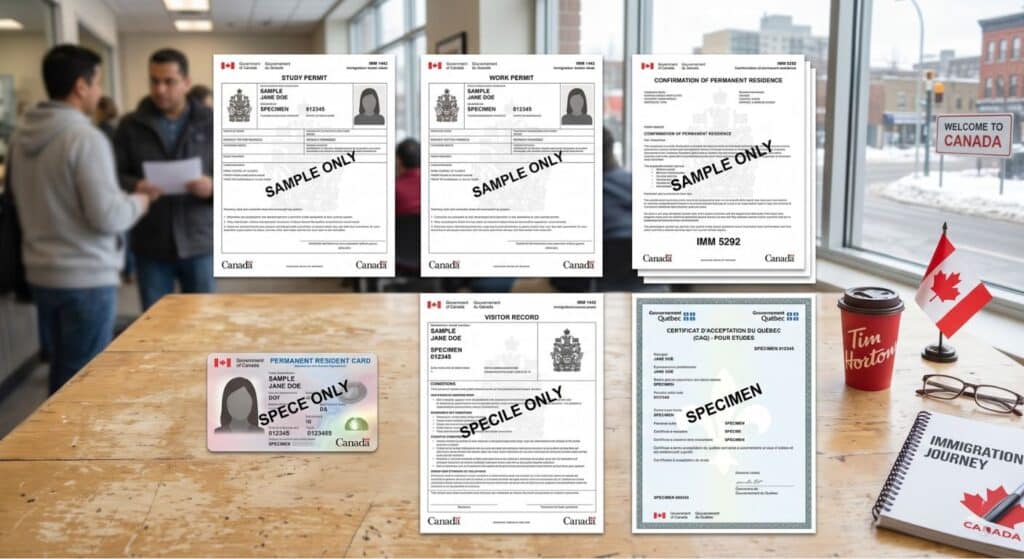
Who is eligible for an open work permit?
You may be eligible if you are one of the following:
1. A Spouse or Common-Law Partner
Partners of eligible students and skilled workers, and partners in Canada being sponsored by a Canadian citizen or permanent resident, can apply. A sponsored partner can work while the sponsorship application is processed.
2. A Recent Graduate of a Canadian School
Graduates of eligible programs at Canadian DLIs can apply for a PGWP after finishing their studies. How long it lasts depends on the length of the program.
3. A Refugee Claimant
People who have filed a refugee claim in Canada can apply so they can support themselves financially while the claim is processed.
4. A Temporary Resident Permit (TRP) Holder
Some people who hold a TRP, which is issued when someone is otherwise inadmissible to Canada (for example on medical or criminal grounds), can be issued an open work permit to support themselves during their stay.
5. A Family Member of a Foreign Diplomat
Spouses and dependent children of foreign representatives posted to Canada may be eligible to work during the posting.
6. A Young Person Taking Part in IEC
Working Holiday participants from partner countries receive an open work permit for the length of their participation.
Benefits of an open work permit
Flexibility
Work for any eligible employer in Canada and change jobs, occupations or cities without applying for a new permit.
No Job Offer Required
You can apply without an employer, so you can arrive or stay in Canada first and look for work afterwards.
Canadian Work Experience
Skilled work done on an open work permit can count towards permanent residence, for example through the Canadian Experience Class.
Families Stay Together
Spousal and common-law partner permits let couples live and work together in Canada while a study, work or sponsorship application is under way.
Support for Refugee Claimants
Refugee claimants can earn a living during what is often a long wait for a decision.

How to apply for an open work permit
The exact steps depend on your category, but most applications follow this pattern:
1. Check Your Eligibility
Read the IRCC page for your category and confirm you meet every requirement before you pay any fees.
2. Gather Your Documents
Common documents include a valid passport, proof of your status in Canada, proof of relationship (for spousal permits) and proof of eligibility, such as a letter confirming you completed your program for a PGWP.
3. Complete the Forms and Pay the Fees
Most people apply online through their IRCC account, which generates the forms and the document checklist for your situation. Fees are paid online when you submit.
4. Submit Your Application
Submit online, or through a Visa Application Centre (VAC) if you are outside Canada and cannot apply online. Make sure every required document is included; incomplete applications can be returned or refused.
5. Give Biometrics or Attend an Interview (If Asked)
IRCC may ask for your fingerprints and photo, a medical exam or an interview. Respond by the deadline in the request.
6. Wait for a Decision
Processing times depend on your category, where you apply from and how many applications IRCC is handling. Check the current processing times on the IRCC website.
What documents do you need?
The documents depend on the type of permit you are applying for. Your IRCC checklist may include:
- Completed application forms
- A valid passport
- Proof of your current status in Canada (if applying from inside Canada)
- Proof of relationship, such as a marriage certificate (spousal permits)
- Your partner's proof of status (if applicable)
- Proof you completed your program (PGWP)
- Labour Market Impact Assessment (employer-specific permits only)
- A valid job offer (employer-specific permits only)
- Certificat d'acceptation du Québec (CAQ) (if applicable)
- Civil status documents
- Medical exam results (if required)
- Digital photos
- Proof that you paid the fees
Processing time and fees
Processing times vary from a few weeks to several months, depending on the category, whether you apply from inside or outside Canada, and how complete your application is. At the time of writing, the work permit processing fee is $155 and the open work permit holder fee is $100, but fees are adjusted regularly, so check IRCC's fee list before you pay.
How to extend your work permit in Canada
If your work permit is close to its expiry date, you may be able to extend it or move to a different permit. Planning ahead matters: you must stay within the conditions of your current permit, and you must stop working if your permit expires before you have applied for a new one.
Apply before your permit expires. If you apply for an extension while your current permit is still valid, you keep maintained status: you can stay in Canada and keep working under the same conditions until IRCC makes a decision, even if your permit expires in the meantime. Keep the confirmation that you submitted your application, as employers may ask for it.
Steps to extend or change your work permit
Most extensions, and changes to the conditions of a permit such as a new employer, are applied for online from inside Canada. You can generally apply from inside Canada if you:
- Hold a valid work or study permit and have met its conditions;
- Are the spouse, common-law partner or dependent child of someone with a valid study or work permit;
- Are allowed to work in Canada without a permit;
- Hold a valid Temporary Resident Permit valid for six months or more;
- Are a refugee claimant, protected person or applicant for permanent residence covered by section 207 of the Immigration and Refugee Protection Regulations (IRPR); or
- Are in Canada as a trader, investor, intra-company transferee or professional under the Canada-United States-Mexico Agreement (CUSMA).
1. Get Ready to Apply Online
You will need an IRCC account, a scanner or camera to make electronic copies of your documents, and a credit card or debit card that can be used online to pay the fees.
Documents you will usually need:
- Your passport pages showing your passport number, issue and expiry dates, name, date of birth and the stamp you received when you entered Canada
- Your current work or study permit
- Proof of relationship, such as a marriage certificate (if your status depends on your partner)
- A letter of employment or job offer (for employer-specific permits)
- Proof that you paid the fees
If you cannot apply online because of a disability or a problem with the online application, you can ask for a paper application.
2. Read the Instruction Guide
IRCC publishes an instruction guide for work permit applications from inside Canada. It explains every form and field, and reading it first avoids the most common reasons applications are returned.
3. Fill Out the Forms
Your answers to the online questions decide which forms and documents your application needs, so answer them carefully.
4. Upload Everything to Your Online Account
Your IRCC account is where you upload documents, pay fees, receive messages about your application and get the decision.
5. Pay the Fees and Submit
Your application is not complete until the fees are paid. These usually include:
- The work permit processing fee (currently $155)
- The open work permit holder fee, only if you are applying for an open work permit (currently $100)
After you submit, you receive a confirmation in your account. If you applied before your permit expired, that confirmation shows you are on maintained status and can keep working under your current conditions until a decision is made.
6. Changing Jobs
With an open work permit, you can change employers at any time while your permit is valid; no new application is needed.
With an employer-specific permit, you normally need a new permit before you start working for a new employer. Depending on the job, the new employer either obtains an LMIA or, if the job is LMIA-exempt, submits an offer of employment through the Employer Portal and pays the employer compliance fee. IRCC has at times run a temporary policy that lets workers start the new job while the new permit is processed; check whether one is in effect before you switch.
Labour Market Impact Assessment (LMIA): ask early whether your new employer needs one. An LMIA takes time and money, and not every employer is willing or able to apply, so raise it before you accept an offer. See our LMIA jobs for employers that already have one.
7. Apply for a Bridging Open Work Permit
A Bridging Open Work Permit (BOWP), issued by Immigration, Refugees and Citizenship Canada (IRCC), lets you keep working while your permanent residence application is processed, closing the gap between your current permit expiring and a final decision.
Because it is an open permit, you are not tied to one employer: you can change jobs, employers or locations without applying for a new permit each time. Staying employed without a gap also protects your status and your work history.
Requirements: you must be in Canada, hold a valid work permit (or be on maintained status) that is due to expire, and have already applied for permanent residence through an eligible program, such as Express Entry, a Provincial Nominee Program or one of the caregiver or agri-food pathways. You apply online through your IRCC account.
8. Consider a Working Holiday Through International Experience Canada (IEC)
If you are a young citizen of a partner country, the Working Holiday category of International Experience Canada (IEC) offers an open work permit that lets you work for almost any employer while you travel and live in Canada.
Eligibility depends on your citizenship and age (usually 18 to 30 or 35), and the permit is typically valid for 12 or 24 months. Candidates enter a pool and are invited in rounds during each season, so apply early.
Whether you extend your current permit, apply for a bridging permit or use a Working Holiday, there is often more than one way to keep working legally in Canada. Choose the one that fits your plans.
Permanent residence vs. work permit
Permanent residence (PR) and a work permit both let you work in Canada, but they are very different. A permanent resident has the right to live in Canada indefinitely. A work permit is temporary permission to work, usually for a set period, and in many cases for a specific employer.
What Is Permanent Residence?
Permanent residents can live, work and study anywhere in Canada, are covered by provincial and territorial health insurance, and can apply for citizenship once they meet the residency requirement. The most common routes are the Express Entry system, the Provincial Nominee Program (PNP) and family sponsorship, each with its own eligibility criteria and application process.
What Is a Work Permit?
A work permit is a temporary document that lets a foreign national work in Canada. Employer-specific permits are issued mainly through the Temporary Foreign Worker Program (TFWP), which usually requires an LMIA, and the International Mobility Program (IMP), which does not. Open work permits, such as the PGWP, fall under the IMP. A work permit does not give you permanent residence.
Key Differences at a Glance
Permanent Residence
- 1. Legal Status
Live and work anywhere in Canada - 2. Duration
Indefinite; the PR card is usually renewed every five years - 3. Citizenship
Can apply for citizenship after meeting the residency requirement - 4. Rights
Most of the rights of citizens, but cannot vote or run for office - 5. Family
Can sponsor a spouse, partner, children and some other relatives - 6. Health Care
Covered by provincial or territorial health insurance - 7. Government Benefits
Eligible for most social benefits, such as the Canada Child Benefit - 8. Education
Children attend public school; domestic tuition at colleges and universities - 9. Work
No job offer or work permit needed - 10. Keeping Status
Must spend two years in every five in Canada - 11. Travel
Re-enter Canada with a PR card or PR travel document
Work Permit
- 1. Legal Status
Temporary permission to work, often for one employer - 2. Duration
Fixed end date printed on the permit - 3. Citizenship
No direct path; Canadian work experience can lead to PR - 4. Rights
Limited to the conditions on the permit - 5. Family
Family members need their own permits or visas - 6. Health Care
Varies by province; private insurance may be needed at first - 7. Government Benefits
Limited access, depending on the benefit and province - 8. Education
Minor children can usually attend school; adults need a study permit for most programs - 9. Work
Must follow the permit's employer and occupation conditions - 10. Keeping Status
Must extend or change the permit before it expires - 11. Travel
May need a visitor visa or eTA to re-enter Canada
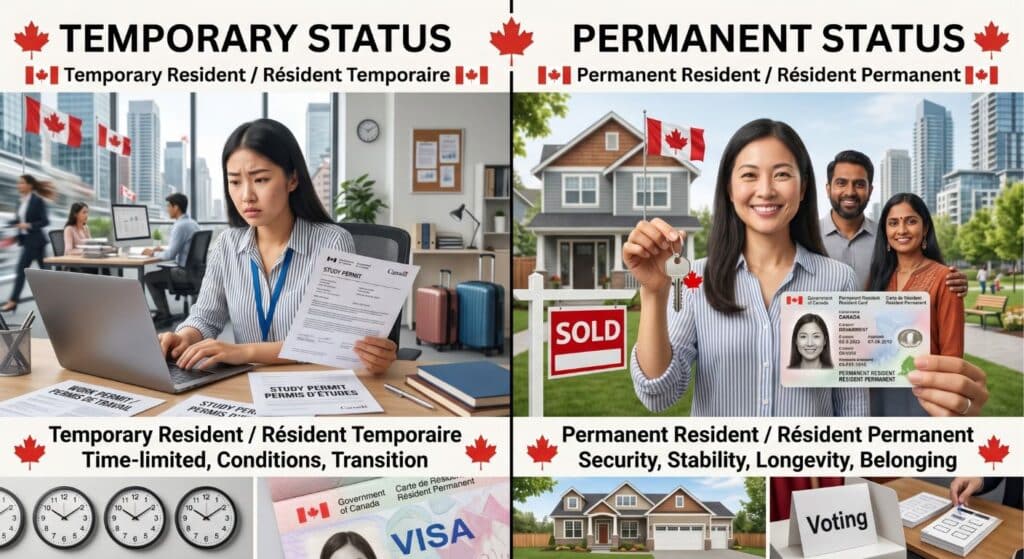
Moving from a work permit to permanent residence
Many people who come to Canada on a work permit later become permanent residents. The main routes are:
- Canadian Experience Class (CEC): for people with at least one year of skilled, paid work experience in Canada (TEER 0, 1, 2 or 3) in the last three years, plus the required language test results. No job offer is needed.
- Federal Skilled Worker Program (FSWP): for skilled workers with foreign or Canadian experience who score at least 67 points on the program's selection grid (education, language, experience, age, arranged employment and adaptability).
- Provincial Nominee Program (PNP): provinces and territories nominate workers who meet local labour needs, often people already working there.
- Quebec programs: Quebec selects its own immigrants, including through the Quebec Experience Program (PEQ) for people who have worked or studied there and speak French. Check Quebec's immigration ministry for which streams are currently open.
The Express Entry Process
Once you meet the basic requirements, which usually means taking an approved language test (such as IELTS, CELPIP or TEF) and, if your education is from outside Canada, getting an Educational Credential Assessment (ECA), you create an Express Entry profile. You are given a Comprehensive Ranking System (CRS) score and placed in the pool.
If you receive an Invitation to Apply (ITA), you have 60 days to submit a complete application with your documents, police certificates and medical exam. IRCC aims to process most Express Entry applications within about six months. If you are approved, you receive a Confirmation of Permanent Residence (COPR) and complete the final step of becoming a permanent resident.
Cost of Permanent Residence
Government fees are charged per person: a processing fee and the right of permanent residence fee for each adult, and a smaller fee for each dependent child. On top of that, budget for language tests, the ECA, medical exams, police certificates and biometrics. Check IRCC's current fee list, as fees are adjusted regularly.
Processing Time
Processing times depend on the program. Express Entry applications are usually the fastest, while PNP applications outside Express Entry and family sponsorships often take longer. Check the IRCC processing times page for current estimates.
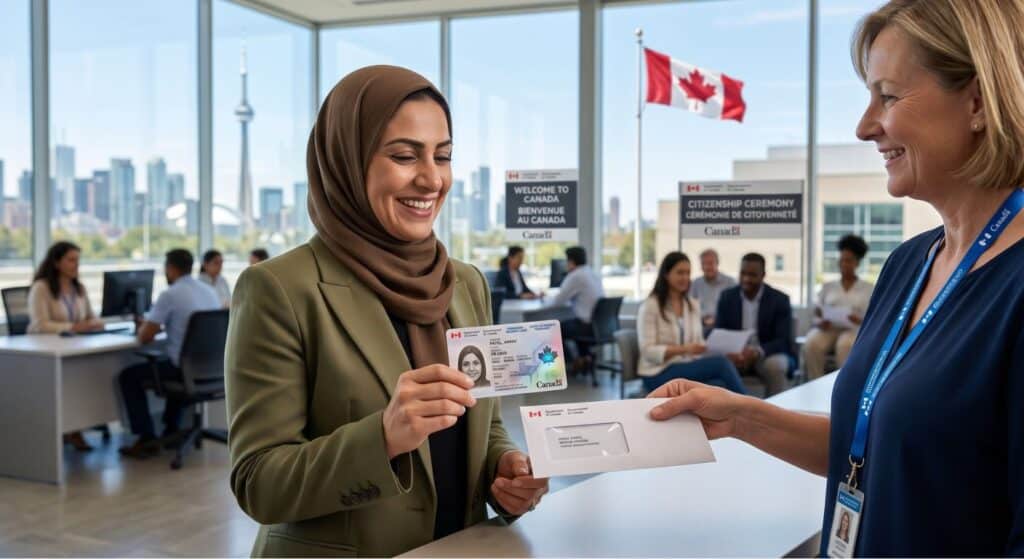
Conclusion
An open work permit is one of the most flexible ways to work in Canada: no job offer, no LMIA and the freedom to change employers. Keeping your permit valid, and applying for an extension before it expires, protects your status and builds the Canadian work experience that can lead to permanent residence.
Permanent residence and a work permit serve different goals. PR is long-term and leads to citizenship; a work permit is temporary and tied to its conditions. If you plan to settle in Canada, use your time on a work permit to qualify for a PR program such as the Canadian Experience Class or a Provincial Nominee Program. Ready to start? Browse jobs across Canada.
Emplois où postuler maintenant
Les derniers emplois affichés sur Centre d'emploi Canada.
Cuisinier à la chaîne
Something Else Restaurant
Spécialiste en conception assistée par ordinateur (CAO) — dessin
Helio Construction Ltd.
Gérant de restaurant
Sushi Wara
Gardien d'enfants à domicile
Karima Family