

Canada is bracing itself for an invasion of undocumented immigrants, most of them from India, as the records for the number of work permits that expired in 2025 have been broken in 2026 by one million and 927,000 respectively. Canada might soon have to fight a rearguard action against a flood of undocumented migrants, 50% of them from India, in the nightmarish working out of its record numbers of expired work permits in 2025 and 2026.
When these work permits expired, their recipients became undocumented, living illegally in the country unless they switched to another visa status or obtained permanent residence. All these alternatives to stay—in particular, pathways of it—have become significantly more difficult as the Canadian state has put additional brakes on immigration, especially non-permanent categories of it (student and temporary visa holders), and established new standards to counter new data regarding asylum seekers.
It’s going to be really chaotic, referring to the mass of immigrants who are at risk of losing their papers. Canada has never faced these kinds of numbers of people losing status before. In the first quarter of 2026 there will be a record-breaking amount of almost 315,000 expiries, meaning a “bottleneck” in the system. In Q4 2025 there were just over 291,000.
It is reasonable to expect that there will be two million or more undocumented migrants in Canada by mid-2026, with not less than 50 percent from India. This rising undocumented population in the country has given rise to some social problems, like the camps in the wooded lands of the GTA like Brampton and Caledon.
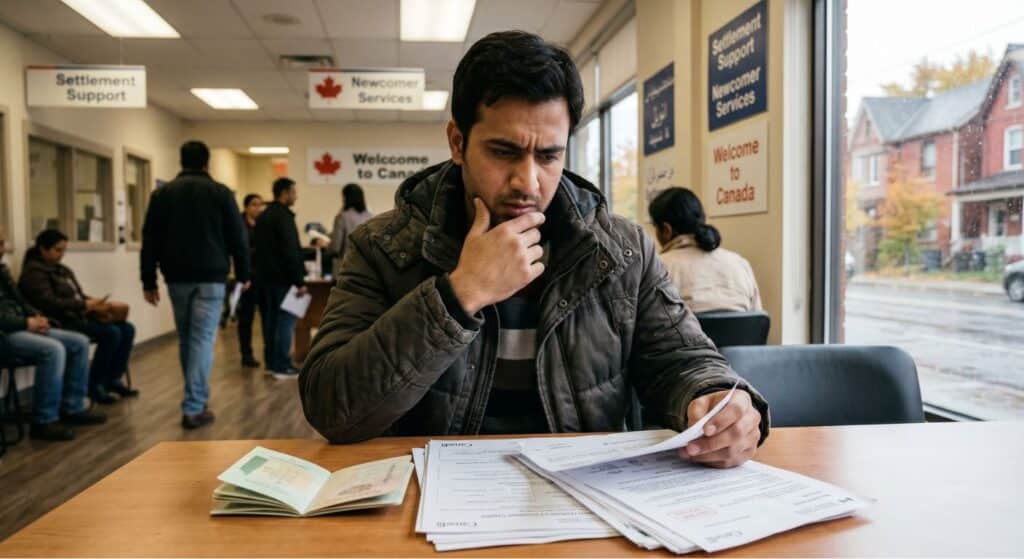
How many undocumented migrants live in Canada?
Because of this and the fact that the number of undocumented migrants in the country is relatively low, Canada’s immigration system has policies that:
Calculating the number of undocumented migrants in Canada—those who are living in Canada without valid immigration status (such as overstayers, rejected asylum seekers, or those who have entered irregularly)—is a difficult task, as it is notoriously hard to track these populations of people. Official statistics are inaccurate, and different projections on their numbers can be made according to different methods of estimate and data collection, as well as recent policy changes.
Recent Projections and Surge Factors (2025-2026)
Recent policy revisions, with lower entry levels through temporary resident admissions and more restrictive rules for jobs and study permits, have resulted in studies forecasting a steep rise in undocumented residents.
If millions of these Permits to stay are later allowed to expire without renewal avenues.
Total Projections
Extrapolation to mid-2026 indicates that total volumes of undocumented migrants may rise to as many as two million backlogs, with over one million work permit expiries expected in 2025 and 927,000 in 2026. The estimated expiry figure for Q1 2026 alone was close to 315,000, resulting in a bottleneck within the system. Additional drivers considered include study permit expiries and asylum claim denials.
Demographic Breakdown
Much of this increase is predicted to be among Indian nationals; up to 1 million of the undocumented Indian population is expected to arrive by mid-2026}.
That’s according to data from Immigration, Refugees and Citizenship Canada (IRCC) that indicates similar numbers of Indian temporary residents whose permits are also running out in an era of narrowing options to obtain Permanent Residency. Larger numbers from immigration consultancies estimate that the overall stay-behind population is somewhere between 600,000 and over 1 million by mid-2025.
Geographic Distribution
The undocumented population lives in urban centers: in Canada, for example, Toronto is thought to be home to about 50% of all undocumented migrants, meaning up to 300,000 people could be living there based on 2025 estimates.
Several other major cities in terms of population are Vancouver, Montreal, Calgary, Edmonton, Ottawa-Gatineau, Winnipeg, Hamilton, Kitchener-Cambridge-Waterloo, and London, although no other specific breakdowns besides Toronto are provided in the sources.
Anyway, by no means, one thing is clear: that those old numbers might have now grown geometrically considering the recent expiration of the visas at the end of 2025 and its domino effect on the year 2026.

Reduced legal exits increased risk of illegality
Currently, if a temporary resident’s permits run out, he or she has 90 days to apply for restoration. During this “restoration window,” they are prohibited from work, application fees are often exorbitant, and processing times can extend for many months. With the numbers of expiry applications skyrocketing, many migrants are in a lose-lose situation of either leaving Canada or going underground. Activists are organizing. The Naujawan Support Network, a group supporting migrant worker rights, has announced a demonstration to take place in January for just this reason.
A looming undocumented population crisis
Immediately after the expiration of the work permit, the acquired status of the holder is lost unless the holder obtains a new Visa or qualifies for Permanent Residency. Nonetheless, recent adjustments to the immigration policy instituted by the Canadian government drastically restrict those alternatives, especially for temporary workers and students.
For now, Canada argues the steps are needed to set things right. But immigration professionals believe a perfect storm of mass permit expirations, the limited legal avenues, and sluggish processing might result in exactly what the policy seeks to prevent. If as little as a small proportion of those losing legal status stay on, Canada might soon have one of its biggest ever undocumented populations, most of them Indians.
Impact already visible
The impact is already being observed in other areas of the Greater Toronto Area, such as Brampton and Caledon. There have been tent colonies forming in some of the woodlands, where people are seeking shelter. They have expired immigration status.
Warning for temporary residents
Silva said that IRCC information and recent changes in policy should be alerted to the “temporary residents.” For Indian citizens, it is extremely important to plan ahead and get legal advice at the right time. In the next two years, he warned, there may be an “unprecedented” rise in the number of undocumented migrants. It is getting more difficult to naturalize.
What was different during the Carney government
The scope has been further widened by a comprehensive policy overhaul under the Carney government. The government has implemented stringent limits on inflows of migrants through 2028, for permanent migrants, international students, temporary workers, and refugees.
A reduced number of target permanent residences to 380,000 in 2026. A severely reduced intake of temporary foreign workers and decreases in student visas and refugee admissions. In September, the government revealed it would undertake a series of reforms to its Temporary Foreign Worker Program.
Carney noted that Canada requires “a targeted strategy” in the immigration policy that satisfies the needs of the labor market and alleviates the burden of housing, infrastructure, and social services. He also promised to scale down the proportion of nonpermanent residents (now approximately 7 percent of the population) to five percent by the end of 2027.

Why Is Canada Limiting Legal Immigration?
Almost 1.2m people—both permanent residents and temporary residents (including students and temporary foreign workers)—were welcomed into Canada during 2022-23, making it the most rapid population increase since the 1950s.
Public worry has risen with these pressures. According to a survey by the Angus Reid Institute, 28% of Canadians are considering leaving the province they currently reside in due to high housing prices. A separate survey by Ekos revealed that 44.5% of respondents believe inflated immigration rates have contributed to the housing crisis.
Meanwhile, the health system in Canada is critically strained, with hospital emergency rooms nationwide functioning way over capacity because of a deficit of doctors and clinics for a fast-growing populace.
These domestic forces, along with external considerations (such as the fact that the US government, under Acting President Donald Trump, has tried to limit immigration and the trade deficit through policies such as imposing heavy tariffs), have compelled the Mark Carney government to shrink the immigration policy.
See how temporary residents currently in Canada can maintain their status
This is not legal advice, but the practical steps are straightforward:
- Expedite tracking expiry date sessions early on and allow for a time margin.
- Where applicable, request extensions or status changes well before expiry.
- Maintain records showing you have met the conditions of the permit (authorization for work, school enrollment, and address changes where necessary).
- If you are facing a complicated situation (like a refused application, expired status, or processing multiple statuses together), ‘talk to a licensed immigration professional.’
The greatest integrity risk to individuals is delaying until after expiry and believing the system will “resolve itself.” In a tightening environment, the delays cause a knock-on effect. The canex wave of expiring permits is very real, and the numbers presented in Parliament demonstrate it to be so.

Conclusion
Canada is preparing for an historic surge of undocumented residents in 2026 as more than two million employment authorizations expire due to the stricter immigration ceilings after Prime Minister Mark Carney. The options for foreign students and graduates shrank equally; there are not many options to establish residency for them anymore. For anxious Indians as deadlines approach, many hundred Indian community groups in the Greater Toronto region witnessed tent villages and an increase in undocumented workers paid under the table. Mobility advisers are encouraging Indian assignees to submit restoration applications during the 90-day grace period, and to revisit intra-company transfers back to India or the US. Tech giants are considering remote work safeguards as a way to keep skilled workers intact. Analysts fear Canada could inherit a legal “shadow workforce” in the millions by mid-year without policy change.