

The Open working papers allow a candidate to figure in Canada even if they need no specific job offer. So, to get an Open working paper, a worker doesn’t require a Labour Market Impact Assessment (LMIA) report or employment offer. Open work permits allow eligible foreign nationals to apply for any employer in Canada. The most important advantage of holding an open working paper is the freedom to figure within the occupation, or for the employer, of your choice.
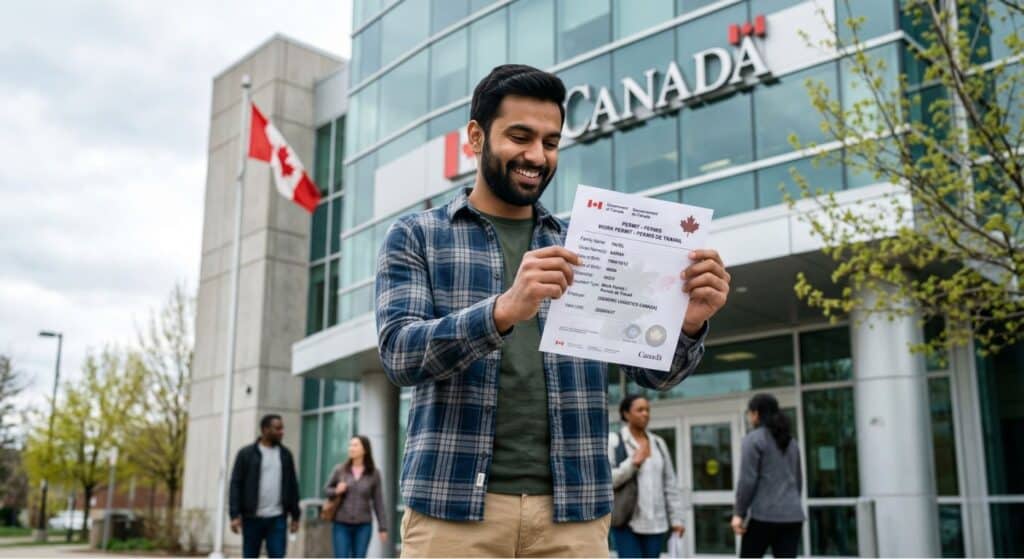
What is an Open Work Permit?
Most foreign nationals who want to return to Canada to study must have legal authorization via a piece permit. Open work permits are one among many sorts of labor permits that allow foreign workers to legally add Canada.
There are two sorts of work permits in Canada: closed work permits that are tied to one employer and open work permits that allow foreign nationals to work in Canada for any number of employers and in various locations.
The biggest advantage of open work permits is that they permit freedom of movement, whether it’s between workplaces, employers, occupations, or locations in Canada. Open work permits are exempt from a number of the wants related to obtaining a permit to figure in Canada.
You do not have to have an employment offer or a positive Labour Market Impact Assessment to be eligible for an open working paper. Some open work permits may have extra restrictions that foreign nationals have to fulfill to qualify for the permit. However, the open working papers holder will need to pay a piece permit fee.
Types of Open Work Permits in Canada
There are differing types of Open Work Permits (OWP) available in Canada, each with its own set of eligibility criteria and conditions.
Here are a number of the foremost common sorts of open work permits:
Unrestricted Open working papers
This type of labor permit allows the holder to figure for any employer in Canada, in any occupation, and any location. These permits are usually issued to individuals who are eligible for permanent residences in Canada, like those who have applied for permanent residency through Express Entry or a Provincial Nominee Program.
Spousal Open working papers
This type of labor permit is issued to the spouse or common-law partner of a Canadian citizen or permanent resident. It allows the holder to figure for any employer in Canada, but just for the duration of their spouse’s or partner’s study permit or working papers.
Bridging Open working papers
Bridging open work permits are special work permits issued to people with existing work permits that are getting to expire soon. Such applicants have usually applied for permanent residence and are awaiting the choice on their application.
Post-graduation working papers
A post-graduate working paper may be a special sort of open working paper granted to international students who have completed an education program at a Canadian designated learning institution (DLI). These permits have a validity length of between 8 and 36 months, depending on the length of the study program.
International Experience Canada (IEC)
This type of labor permit is out there for children from countries that have a reciprocal agreement with Canada. The permit allows the holder to stay in Canada for up to 2 years, counting on the agreement, and is usually issued for working holidays, international co-op programs, or young professional work experience.
Humanitarian and Compassionate Open working papers
This type of labor permit is issued to individuals who are in Canada on humanitarian and compassionate grounds. If you’ve made a refugee claim in Canada and are expecting a choice, you’ll be eligible for open working papers.
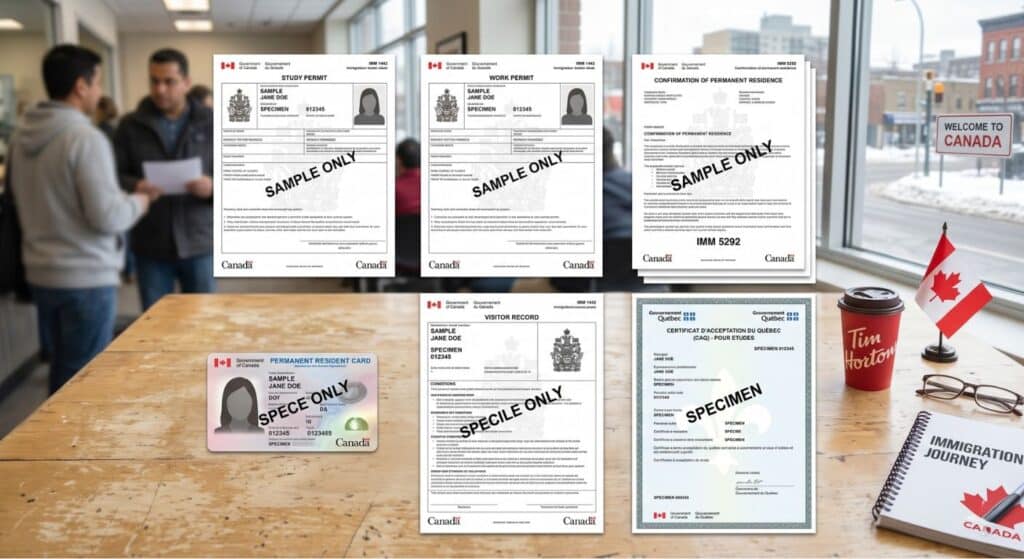
Eligibility for open working papers in Canada
To be eligible for open working papers in Canada, you want to be one among the following:
- Spousal/Common-law Partner Open working papers
Married or common-law partners of Canadian citizens or permanent residents can apply for this sort of open working paper. It allows them to stay in Canada while their partner sponsors them for permanent residence.
2. Post-graduation working papers (PGWP)
Graduates from eligible Canadian institutions may obtain an open working paper, referred to as a PGWP, after completing their studies. The length of the PGWP varies depending on the duration of the program.
3. Refugee Claimants
Individuals who have filed a refugee claim in Canada can also be eligible for open working papers, allowing them to support themselves financially while their claim is being processed.
4. Temporary Resident Permit (TRP) Holders
Those with a TRP thanks to their inadmissibility to Canada on medical or criminal grounds could also be issued open work permits to assist them support themselves during their stay in Canada.
5. Dependent Children of Foreign Diplomats
Children of foreign diplomats posted in Canada could also be eligible for open work permits, which permit them to figure out and gain valuable experience. The young workers that are participating in the IEC program.
Benefits of open work permit in Canada
Flexibility
Open work permits allow you to figure for any employer in Canada, supplying you with the liberty to explore various job opportunities.
No Job Offer Required
Unlike other work permits, you don’t need an employment offer to use for open working papers, making it accessible to a good range of people.
Canadian Experience
For international graduates, open work permits provide a chance to realize valuable Canadian work experience, which may be beneficial when applying for permanent residency.
Family Reunification
Spousal/common-law partner open work permits promote family reunification by allowing partners to figure out and live together in Canada while the sponsorship application is in process.
Support for Asylum Seekers
Open work permits for refugee claimants help them support themselves during the usually lengthy process of getting their claims assessed.

How to Apply for an Open Work Permit in Canada
The application process for open working papers varies depending on the category you fall into.
Gather Required Documents
Common documents include a legitimate passport, proof of relationship (if applicable), and proof of eligibility, like a study permit for PGWP applicants or a sponsorship application for spousal/common-law partner open work permits.
2. Complete the appliance Form
You’ll have to fill out the acceptable form, which may be found on the IRCC website. concentrate on the precise instructions for your category.
3. Pay the Processing Fee
Most open working paper applications require a processing fee, which may be paid online. make sure you include the payment receipt together with your application.
- Submit Your Application
You’ll submit your application online through the IRCC website or a Visa Application Centre (VAC), depending on your location. make sure that your application is complete and everyone’s required documents are included.
- Biometrics and Interview (if required)
Some applicants may have to supply biometrics or attend an interview at the request of IRCC. Confirm to suit these requests promptly.
- Wait for Processing
The time interval for open work permits can vary depending on the category and therefore the volume of applications. Check the present processing times on the IRCC website for the foremost accurate information.
What documents are required for a Canadian open work permit?
The documents required for Canadian working papers will depend upon the sort of labor permit you’re applying for. Applicants may have to supply the subsequent documents as a part of their working papers application:
Completed application forms
Labor Market Impact Assessment (if applicable)
Valid job offer (if applicable)
CV/ Resume
Civil status documents
Certificat d’acceptation du Québec (CAQ) (if applicable)
Proof that you simply meet the work requirements
Valid passport
Education credential Assessment
Medical examination report
Receipt of payment for IRCC fee.
Photographs for application purposes.
Legal status in Canada (if already inside Canada).
Family member’s proof of status (if applicable).
Processing time for Open Work Permit applications
The time interval for an Open Working Papers Canada application can vary depending on a variety of things, like the completeness of the appliance and the way busy the visa office is. However, applicants can expect to receive a choice on their application within a couple of weeks.
Complete Guide About How To Extend Your Work Permit in Canada
By extending your working papers, you make sure that you’ll legally continue working in Canada with no interruptions and fully suit Canadian immigration laws. A Canadian working paper is important for anyone seeking employment in Canada, as they legally authorize individuals to figure within the country.
It is crucial not only to get a piece permit but also to satisfy all the conditions outlined within the permit during your stay. Furthermore, it’s important to prevent working immediately if your working papers expire to avoid any legal complications.
Also, by extending your working papers, you make sure that you’ll legally continue working in Canada with no interruptions, fully complying with Canadian immigration laws. This legal continuity is crucial for maintaining your career progression and private development.
If your Canada working paper is close to reaching its expiry date and you’re seeking information on extending it, it’s essential to know that there are various methods available for obtaining a piece permit extension. If you’re eligible, understanding the way to extend your open working papers in Canada is often an easy process, because it allows you to seamlessly continue exploring the abundant opportunities within the Canadian job market.
How to Extend Your Working Papers in Canada
The primary thanks for extending your working papers in Canada, provided you would like to continue working in your current occupation, is to vary the conditions of your current working papers. This takes an easy five-step process.
To be allowed to increase your working papers, you want to make sure you fulfill all eligibility requirements. To be eligible, you must:
- Already hold Canadian working papers and have continued to satisfy the wants of your existing working papers.
- Be married to someone with a study or work permit;
- Be authorized to figure without a permit;
- Have a legitimate Temporary Resident Permit;
- Be a refugee or applicant for permanent residence in Canada under section 207 of the IRPR,
- Be in Canada as a trader, investor, transferee, or professional under the Canada-United States-Mexico Agreement (CUSMA).
Gather the required Resources
Applying online is the easiest method to use for a piece permit extension. A number of the wants needed to increase your add Canada includes having a scanner or camera to make electronic copies of your documents and a legitimate credit card i.e. debit or MasterCard.
To apply, you would like the following documents:
- Your Proof of Payment for application fees
- Your Passport number, date of issue and expiration, name, date of birth, and authoritative Canadian stamp made once you arrived in Canada must all be visible on your travel documents
- Your current immigration document
- Your marriage license or certificate
- Letter of employment (if necessary)
- You’re allowed to submit a paper application if you can’t apply online thanks to a disability or a drag together with your online application
2.Read The Instruction Guide
Extending your open working papers in Canada is often a touch tricky, but reading the instruction guide can make it simpler. Once you start the appliance, there are various forms to fill out. Fortunately, the Canadian government features a comprehensive instruction guide available explaining the way to fill altogether the specified forms and guides answering each field.
3. Fill Out The Forms
Before you upload your documents, you’ve got to fill out several forms to renew your working papers in Canada. The knowledge you provide in these forms will determine which documents you’ll need for your application.
- Submit the finished Forms to your Online Account
Your account is going to be where you upload your documents, pay your processing fees, and receive updates on your working papers application.
2. Pay Fees and Submit Application
For your application to be complete, you would like to pay the following fees:
- Work permit fee (155 CAD)
- Open working papers holder fee (if applicable) (100 CAD)
You only have to apply for an Open working papers holder fee if you’re applying for an open working papers.
A Canada working papers extension time interval is around 166 days. Once you submit your application, you will get a letter from the govt of Canada in your online account. This letter proves that you simply can keep working until your application is processed. You must print this letter out and submit it together with your current working papers when asked for your working papers. This letter will allow you to continue working after your working papers expire.
Find A Replacement Job In Canada
Getting a replacement Job
One way to increase your working papers is to urge a replacement job. If your current permit is ending otherwise you have to change it, a replacement job can help. Here’s the way to do it:
Apply for a replacement Job
Get a replacement job offer from a Canadian employer. Then, apply to increase your working papers. you could start your new job before your permit is approved. invite permission to figure while waiting.
Open working papers
If you’ve got open working papers, you’ll change employers anytime as long as your permit is valid.
Labor Market Impact Assessment (LMIA)
When changing jobs, check if the new employer needs an LMIA. If needed, the employer must apply for it. If not, they need to submit a replacement job offer and pay a compliance fee. Not all employers can or can pay these fees, so discuss this with them.
Bridging Open Working Papers
A Bridging Open working paper (BOWP) may be a sort of working paper issued by Immigration, Refugees and Citizenship Canada (IRCC) that permits individuals to continue working in Canada and preserve their temporary resident status, while they await the processing of their permanent residency application.
This permit helps bridge the gap between the expiration of current working papers and therefore the final judgment on a permanent residency application, ensuring that applicants can maintain their employment status without interruption.
One of the most important advantages of a Bridging Open working paper is that it allows for a seamless transition between your current working papers and your future permanent residency status. This suggests you’ll continue working with no interruptions while your permanent residency application is being processed.
As it is an open working paper you’re not tied to a selected employer. you’ll change jobs, employers, or locations within Canada without having to use a replacement working paper whenever you create a change.
Also holding a BOWP ensures that you simply remain in compliance with Canadian immigration laws. This is often particularly important to avoid any gaps in your employment history, which may affect your eligibility, surely benefits, and opportunities.
Requirements and Application Process
To be eligible for a BOWP, you want to meet certain criteria, including having a legitimate working paper at the time of application and having already applied for permanent residency under one of the eligible programs. The appliance process involves submitting the acceptable forms and documentation to Immigration, Refugees and Citizenship Canada (IRCC).
Get A Working Holiday Visa From International Experience Canada (IEC)
Another option is the Working Holiday Visa which is a component of the International Experience Canada (IEC) program. This visa offers children from partner countries the chance to travel and add Canada for a limited time. This visa is an open working paper, allowing holders to look for any employer in Canada and in almost any sort of job.
The main objective of the Working Holiday Visa is to supply young travelers with the prospect of gaining valuable work experience while exploring Canada. If your current working papers are close to expiring and you’re from one of the partner countries, you’ll apply for this sort of visa.
To be eligible, applicants must be citizens of 1 of the countries that have a youth mobility agreement with Canada and meet the age requirements. The visa is usually valid for up to 12 or 24 months, depending on the applicant’s nationality and therefore the agreements between countries.
The open nature of the working papers means participants can change employers and locations without having to use a replacement permit. There are different paths available for you to continue working in Canada and to increase or renew your working papers.
Whether it’s through securing a replacement job, applying for a Bridging Open working paper, or exploring options just like the Working Holiday Visa, you’ll find an answer that matches your needs.
How PR Visa Is Different From Work Permi
A PR is provided to foreign nationals who have immigrated to Canada but are granted the country’s status of permanent residents by the government. Since the 2 words are entirely at odds with each other, temporary visitors like students don’t receive a PR.
A work permit may be a legal instrument permitting a far off national to interact employed while inside Canada. Each year, Canada issues about half 1,000,000 work permits to temporary foreign workers around the world.
Discover the contrasting features of Permanent Resident Visas (PR Visas) and Work Permits, two immigration options that provide different paths to living and dealing abroad. In this comparative guide, we’ll unveil the differences between PR Visas and Work Permits, to facilitate your informed decisions about your immigration choices and plans to Canada.
What is a PR Visa?
A PR Visa in Canada grants foreign nationals permanent residency, allowing them to measure, work, study, and access social benefits indefinitely. It also provides a pathway to Canadian citizenship after meeting residency requirements.The most common pathways to get a PR Visa in Canada include the Express Entry system, Provincial Nominee Program (PNP), and family sponsorship programs, each with its own eligibility criteria and application processes.
What is a Work Visa?
Canada working papers Visa is an immigration document that permits foreign nationals to figure in Canada for a selected job or employer for a limited period. working papers status may be a temporary authorization and doesn’t grant permanent residency. differing types of labor Permits in Canada include – the Temporary Foreign Worker Program (TFWP), the International Mobility Program (IMP), and therefore the Post-Graduation working papers Program (PGWP), etc, each with its eligibility criteria and requirements.
Difference Between PR Visa and Working Permit
A Permanent Resident (PR) visa and a piece Permit are both immigration options that allow individuals to measure and add a far off country. However, they differ significantly in their purpose, duration, and benefits. the most differences between the 2 are given below :
Permanent Residence
- Legal Status
Allows immigrants to legally live and work anywhere in Canada
- Duration
Indefinite, with PR Card issued for five years (renewable)
- Citizenship Path
Offers a pathway to Canadian citizenship
- Benefits & Privileges
Same rights and privileges as Canadian citizens
- Family Sponsorship
Dependent relations are granted PR rights
- Healthcare Coverage
Eligible for universal health care program
- Social Security Benefits
Eligible for various Social Security benefits
- Educational Benefits
Children have access to free education
- Job Search & Work Authorization
No need for a Canadian job offer or a replacement working papers
- Voting & Political Rights
Cannot vote or run political office
- Maintenance Requirements
Must meet residency requirements to take care of PR
- Application Process
Typically takes 6-8 months for a PR application
- Travel Requirements
Can travel in and out of Canada without TRV/ETA
Work Permit
- Legal Status
Specific authorization for a delegated job or business for a limited period
- Duration
Temporary, typically up to 4 years
- Citizenship Path
No direct path to citizenship
- Benefits & Privileges
Limited access to social benefits
- Family Sponsorship
Family members need separate permits (e.g., study permit)
- Healthcare Coverage
May need private insurance or employer-provided coverage
- Social Security Benefits
Limited or no access to Social Security benefits
- Educational Benefits
Study permits needed for children’s education
- Job Search & Work Authorization
Specific job/employer authorization required
- Voting & Political Rights
No voting rights or eligibility for political office
- Maintenance Requirements
Work permit tied to job duration and employer
- Application Process
Work permit time interval varies counting on the program
- Travel Requirements
WP holders may have a short lived Resident Visa (TRV)
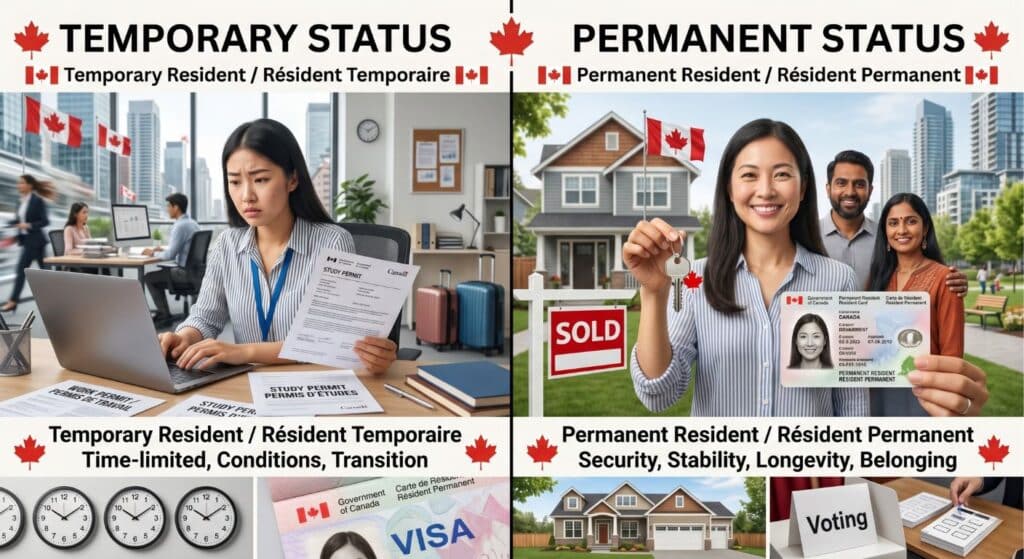
Convert Work Permit to PR in Canada
Transitioning from a piece visa to permanent residency in Canada is feasible, though it’s going to be time-consuming and disruptive. Various programs allow you to use PR if you’re working in Canada.
The most well-known is the CEC or Canadian Experience Class. Before applying for PR under this technique, applicants must have a minimum of two years of labor experience in Canada, a postgraduate degree from a Canadian university, and one year of labor experience.
Quebec Experience Class is another program almost like the CEC. If you’ve worked as a talented worker in Quebec for a minimum of a year and speak French at an intermediate level, you’re eligible to use this program.
Suppose you’re fortunate enough to accumulate a permanent employment offer from a Canadian employer. Therein case, you’ll apply for permanent residence (PR) under the Federal trained worker Program (FSWP), but you’ll have to earn the required number of points. The idea for awarding points is your qualification, age, language proficiency, etc.
Application Process : Canada PR Visa
Create an Express Entry profile and complete the web application once you’ve satisfied all the elemental eligibility requirements, like finishing your Education Credentials Assessment (ECA), getting the specified IELTS score, gathering experience certificates, and other similar things.
You will then receive the Invitation to use (ITA), followed by some background checks conducted by the relevant authorities. you ought to receive your PR confirmation during a few days if everything goes perfectly. you’ll then be required to submit your passport for stamping.
You cannot apply for the PR unless you’ve got 67 points, so we strongly advise you to see your eligibility using online tools before moving further with the method.
Cost : Canada PR Visa
The total cost for a Canada PR visa is 2,500 CAD – 3,000 CAD. This cost varies to support the amount of applicants. it’s the sum of your application fees for you and your spouse and dependents, fees for checkup, English test, ECA fees, PCC fees, etc
Processing time Of Canada PR visa
The time interval for a Canada PR visa can vary counting on the sort of application and therefore the applicant’s circumstances. As of July 2024, the typical time interval for many permanent residency applications is 12–18 months.
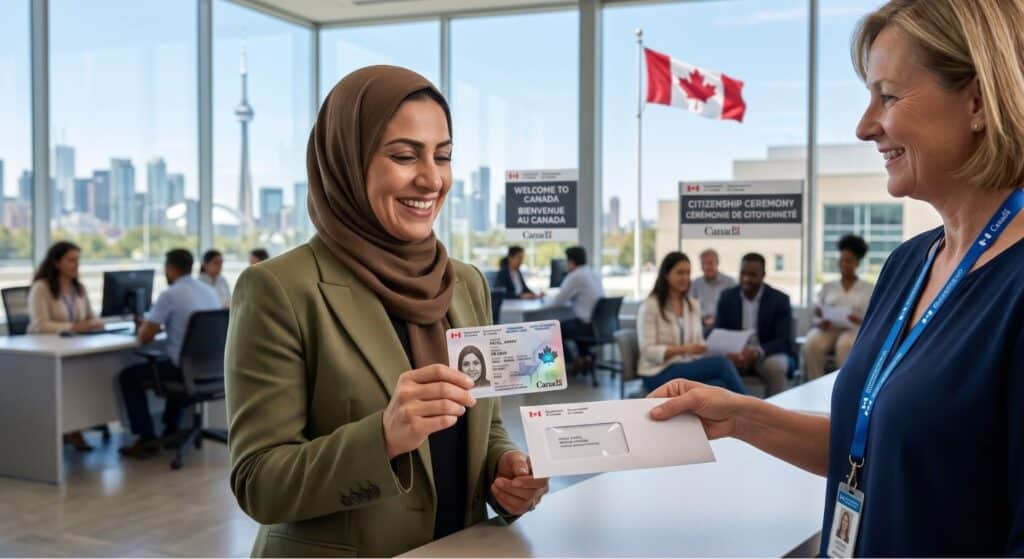
Conclusion
Keeping your working papers valid and staying legally employed in Canada will improve your chances of obtaining Canadian permanent residency. It also ensures you remain in compliance with immigration laws, reducing the danger of penalties or legal issues. Your current status, personal profile, and life goals will determine the simplest path for you. As you’ll see, there are both parallels and considerable distinctions between Canadian permanent residency (PR) and Canadian working papers (WP) statuses. PR visas provide long-term or indefinite permission to reside in a country, with the aim of settlement and eventual citizenship. Work permits, on the opposite hand, are temporary authorizations tied to specific job offers and specialize in employment needs. While PR visa holders enjoy more job flexibility, social benefits, and a pathway to citizenship, working paper holders have limited job flexibility and access to social benefits. Individuals seeking permanent relocation to Canada are typically better fitted to Provincial Nominee Programs that give PR status, whilst those seeking temporary skilled labor in Canada may prefer WP status.