

Truck driving in Canada is a crucial job, as it ensures that thousands of goods make their way through the length and breadth of the country on a daily basis. The increasing demand for truck drivers has now made it a more viable and favorable job for newcomers. If you are a truck driver from another country and are accredited with relevant certifications and experience from home, you will likely have your certifications accredited with any provincial or territorial government before you are allowed to drive a truck in Canada.
In this guide, we will outline the general procedure for anyone wishing to immigrate to Canada as a truck driver. The primary difference here is that you must be granted access to Canada via the country’s immigration streams, and there is often the guarantee of an awaiting job before arrival.
The majority of individuals who are seeking truck driver positions have prior experience working as one. The main question is how to get any of your previous qualifications recognized in Canada. However, prior to commencing work, you are required to possess a valid truck driver’s license. This guide discusses the criteria, stages involved, and possibilities with respect to gaining a Canadian truck driver’s license.
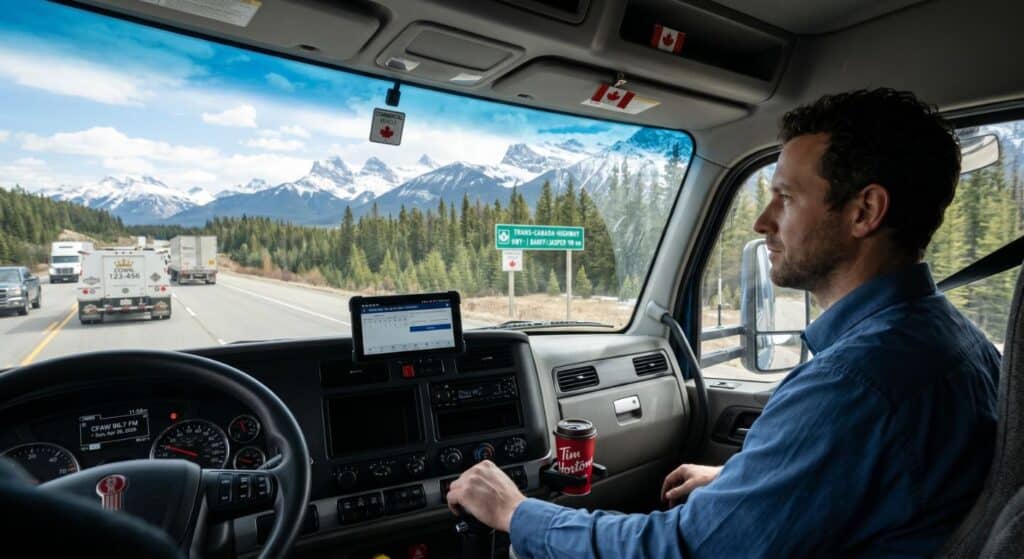
Types of Truck Driver Jobs in Canada
Transport truck drivers in the long-haul category
- These drivers are responsible for transporting products from province to province and internationally.
- They mostly make longer trips lasting several days.
- They operate large trucks such as semi-trailers.
- Transport of goods and commodities from province to province using tractor-trailers, long-combination vehicles, and straight-body trucks weighing more than 4500 kg.
- Coordinating trips and securing transport permits.
- Prior to, during, and after trips, we conduct vehicle checks to inspect various components such as lights, brakes, tires, and cold storage.
- Ensuring cargo is correctly packed and securing potentially hazardous items according to safety standards.
- Obtaining necessary permits and documentation to transport cargo into and out of the country.
- Maintaining records and mileage logs and keeping them either manually or electronically.
- Utilizing on-board computers and road-safe communication systems for contacting dispatchers, clients, and other truck drivers.
- May be required to conduct basic roadside repairs to the vehicle.
- Can lead other truck drivers in convoys or in pairs.
- Are eligible to transport hazardous items.
Regional Drivers
- Drivers within the nation. These trips typically take place in areas where the counties are mostly in one province.
- They don’t usually drive as long a distance as long-haul drivers do.
- Regional drivers can often commute to and from work each day, giving them more time to spend with their families and a better work-life balance.
Drivers who transport goods in the city and local areas (short-haul)
- These drivers usually make deliveries within cities and towns to retailers or businesses in the logistics industry.
- They operate straight trucks to deliver goods from one point to another within the same city or across regions with a few local cities within their route.
- Driving other vehicles such as cement mixing trucks, dump trucks, hydrovac vehicles, and tow trucks is an additional possibility with their licenses.
- Maintaining logs, conducting inspections, and assisting in loading and unloading of the cargo.
Specialty Truck Driver jobs
- These drivers may be licensed to transport oversized objects, volatile or sensitive cargo, or potentially dangerous items.
- To operate these trucks, it may be essential to possess additional certifications and/or training.
Types of Truck Driver’s License in Canada
Although each province or territory in Canada has its own licensing requirements, the following are the types of commercial licenses recognized across the nation:
Class 1: Required for driving semi-trailer trucks (this license type is what most truck drivers possess).
Class 2: Necessary for driving buses, such as school buses and coaches.
Class 3: Required for driving larger straight trucks, such as cement and dump trucks.
Class 4 and Class 5: Permit drivers to operate smaller vehicles such as commercial vans and passenger cars.
The majority of professional truck drivers in Canada are usually licensed under a Class 1 license (also referred to as AZ in Ontario and Class 1A in Saskatchewan).

Steps to Getting Your Truck Driver’s License in Canada
The steps involved in obtaining a truck driver’s license in Canada are a well-defined process to ensure a skilled and safe workforce.
Below are the basic requirements for you to successfully acquire a Canadian truck driver’s license:
Step 1: Learner’s permit
You must first successfully pass the written test on driving laws, safety procedures, and trucking regulations. Some regions may require you to pass a separate air brake test as well.
Step 2: Complete obligatory driver training
A lot of provinces (including Ontario) require you to undergo mandatory truck driver training before taking the test for your truck driver’s license. Such programs will teach you the fundamental rules of driving and what safety measures to apply.
Step 3: Pass the practical driver’s test
After completing all mandatory courses and the written test, you will then need to pass a practical truck driver’s examination while operating a commercial vehicle in various road conditions.
Step 4: Get Your License
Upon passing the driving test, you will be granted your professional truck driver’s license.
Costs and Duration of Driver Training
The cost and duration for gaining your truck driver’s license vary by province and school but may range anywhere from $5,000 CAD to $10,000 CAD for courses lasting between 4 weeks and 3 months (depending on the training’s intensity and schedule). If the company you eventually work for guarantees a position in their organization, they may choose to sponsor your training or repay the expenses incurred once you have begun working for them.
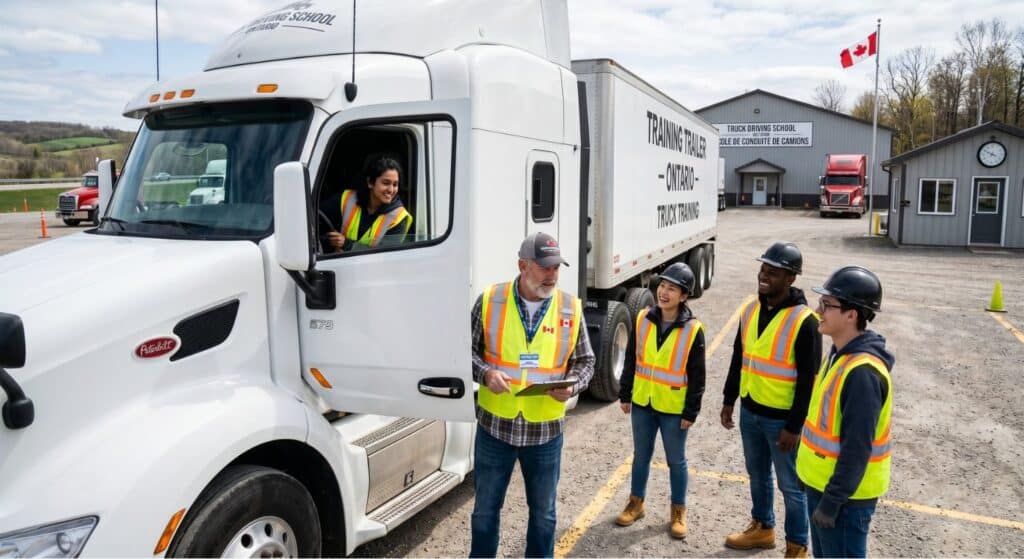
Truck Driver Job Requirements in Canada
Here is a list of things that can make you a successful candidate for a truck driving job in Canada:
- Truck driver license and certifications—You should at least hold a valid Class 1 driver’s license or a Class A commercial driving license (CDL). Additional licenses might be required for specialized truck driving positions.
- Driver education and training—It’s believed that truck driving relies more on your experience and skills rather than education; however, graduating from an accredited truck driving institution can significantly boost your chances of landing a good position and will equip you with essential training in safety procedures.
- Physical condition—Drivers must be physically fit and capable of handling cargo and lengthy driving shifts on the road. Good vision, hearing, and general health are necessary.
- Language skills—Drivers must be fluent in at least one of Canada’s two national languages (English or French) for the purpose of communication and comprehension of safety rules.
- Truck Driver Qualification Checklist:
– Class 1 or Class A CDL driver’s license
– Any special licenses that might be necessary for particular driving jobs
– Completion of truck driver training program
– Physically capable of the task
– Proficiency in English or French
How to Find a Truck Driver Position in Canada for the first time
Searching for a job in Canada is not like doing so in your home country, so you might need help navigating the Canadian labor market. Thankfully, there are settlement services readily available that will assist you in all stages of your job search, including the development of your resume, the composition of cover letters, and the preparation required for interviews.
To guide you further, listed are some tips for finding trucking jobs in Canada:
– Cast your net wider. Search nationwide for trucking jobs, not just in your area.
– Join settlement services’ job finding or networking groups and participate actively in their activities.
– Attend job fairs, company information sessions, and relevant career fairs to learn more about employers and the truck driving industry in Canada.
– Search job boards for trucking jobs to learn what skills and qualifications potential employers are seeking.
– Volunteer for the purpose of obtaining some Canadian work experience.
– Find a mentor in the truck-driving industry that will guide you, offer their expertise, and provide networking opportunities for you.
Networking
It is undeniable that establishing connections and networks within Canada will be crucial in finding employment, so be proactive when the opportunity to network with people in the trucking industry arises. For example, while completing your driver training, participate in classroom discussions with both instructors and classmates to build relationships. This networking opportunity will not only educate you on the specifics of the truck driving industry in Canada but also give you the chance to identify job opportunities within the sector that would otherwise have gone undiscovered, as many companies are unaware of their existence.
Interview Tips for Truck Driver Jobs
Truck driving presents drivers with both difficult tasks and satisfying accomplishments. The hiring managers need to confirm your driving abilities through your past driving experience and your spotless driving record. The hiring team wants to find drivers who deliver outstanding customer service and comprehend the vital nature of safe driving practices. The following questions will be presented to you during your truck driver interview.
- Describe your history of driving commercial trucks. Your driving history should include your driving experience, the licenses you hold, your total driving distance, and your response to exceptional driving situations.
- What steps do you take to create a secure environment for your driving activities? Your safe driving approach should demonstrate your commitment to safety through your compliance with established safety standards and regulations.
- What steps would you take to resolve a major shipment issue? You can showcase your customer service skills with a client relationship by explaining how you maintained customer satisfaction while you found solutions to customer problems.
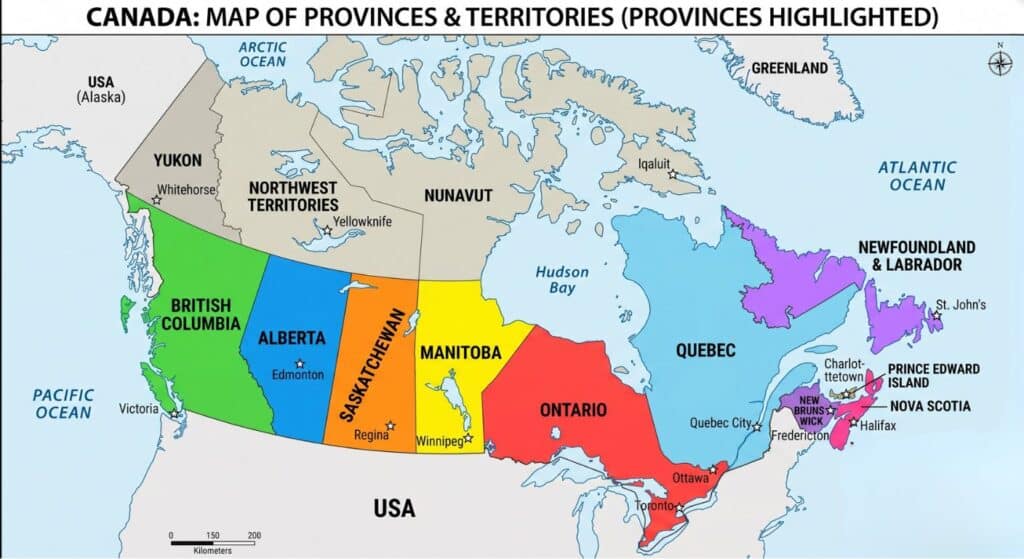
Canada’s top provinces for truck driving jobs
Throughout the entire year, Canada maintains a strong demand for truck drivers! The following are a few of Canada’s best provinces with outstanding opportunities:
British Columbia
British Columbia provides over 400 truck driver job openings while restricting permanent resident status to skilled immigrants, which attracts a diverse group of intelligent and qualified individuals.
The Nova Scotia
The Nova Scotia Nominee Program provides truck driving positions as a pathway for individuals to obtain temporary work permits or permanent residency status.
Alberta
This province has nearly 500 truck driver vacancies available throughout its entire territory. The Alberta Opportunity Stream and the Alberta Express Entry program serve as resources to discover Alberta’s particular requirements and available work possibilities.
Ontario
The Ontario Immigrant Program designates Class 1 truck driving jobs to three out of twelve NOC codes, which results in most applicants receiving nominations for this position. The candidates stand a better chance of getting nominated to work in Ontario because they will probably receive a job offer.
Quebec
Quebec province currently offers more than 837 provincial truck driver jobs which makes it the region with maximum job openings. The candidates who apply for this program tend to attain 9 out of 12 points, which demonstrate their ability to succeed in Quebec’s PNP system.
Advantages of Working as a Truck Driver in Canada
A truck driver in Canada can expect numerous benefits from this profession choice.
High demand and work security
The demand for truck drivers continues to rise because Canada requires drivers to cover its vast territory and its strong economy provides drivers with many chances to advance their careers.
Competitive Salaries
The earnings of Canadian truck drivers depend on their delivery items and travel patterns, which include additional pay for overtime.
Flexible Schedule
You can select any type of work schedule, which includes local city truck driving jobs with family time flexibility and long-distance travel work options.
Immigration Opportunity
The various immigration streams in Canada encourage skilled professionals to pursue this profession, which automatically leads to Permanent Residency in Canada.
Travel and Adventure
You can explore every part of Canada for work because your job takes you from the Atlantic coast to the stunning rocky highlands.
Exceptional Benefits
Canadian companies provide employees with exceptional benefits which include paid time off and health insurance and pension plans.
Opportunities and Training
Intensive training programs equip truck drivers with the skills needed for their upcoming job responsibilities. You can achieve further career advancement through field training or by becoming a fleet manager.
Opportunities in Canada for Truck Drivers
You will have access to several professional options as soon as you have your license. The average annual salary for a truck driver ranges from $50,000 to $80,000 while long-haul drivers receive higher earnings. Canada maintains a constant requirement for drivers throughout the entire country. The Atlantic Immigration Program (AIP) and the Provincial Nominee Program (PNP) provide pathway options to immigrants who match the specific requirements for this sector. The truck driver profession in Canada offers individuals the opportunity to secure employment while simultaneously enhancing their living standards.

Conclusion
Becoming a truck driver in Canada gives you job safety and financial security and professional development and immigration pathways. The demand for truck drivers continues to rise while Canadian companies increase their driver hiring activities. The time has come for all Canadian citizens and immigrants who wish to drive trucks in Canada to submit their applications. The upcoming years will bring job expansion and competitive salaries and permanent resident opportunities to Canada’s transportation sector through 2026 and beyond.